Here's what nobody tells you about pleasure and your cycle
Your body doesn't experience pleasure the same way every single day. If you've noticed that your lemon vibrator or any clitoral vibrator feels wildly different depending on what week of your cycle you're in, you're not imagining it. The sensation can swing from intense and responsive one week to weirdly muted the next. That's not a problem with the toy. It's basic neurobiology.
Hormones like estrogen and testosterone fluctuate throughout your cycle, and they directly affect blood flow to the clitoris, nerve sensitivity, and how quickly arousal builds. Understanding this pattern doesn't just explain what's happening. It helps you work with your body instead of fighting it.
How estrogen affects clitoral sensitivity
Estrogen rises during the follicular phase (from the start of your period through ovulation). When estrogen is high, more blood flows to the clitoris, the tissue becomes more engorged, and nerve sensitivity increases. This is why many people report that their lemon vibrator feels dramatically more responsive during this window. The same pattern, the same intensity dial, produces a completely different sensation.
The clitoris has around 8,000 nerve endings. Estrogen enhances blood flow to those endings, which means faster arousal and often more intense orgasms. If you've noticed that you hit climax faster mid-cycle, that's estrogen at work.
When estrogen drops after ovulation (the luteal phase), the opposite happens. Blood flow decreases, tissue engorgement reduces, and that sensitivity dampens. This is why your lemon clitoral vibrator might feel less responsive in the second half of your cycle. It's not that you're broken or numb. It's that your neurological response has genuinely shifted.
Testosterone's role in desire and sensation
Women produce testosterone too, and it spikes around ovulation. This hormone is a major driver of desire and also affects how intensely you feel stimulation. During the testosterone peak (roughly mid-cycle), you'll often notice not just more interest in sexual activity, but a sharper, more acute sensation from the same vibrator settings.
Later in your cycle, testosterone drops, and with it, that sharpness can fade. The sensation might feel more diffuse, less localized, and require more work to build toward climax. Some people describe it as "the vibrations feel duller" or "I need to use it longer." Again, that's your hormones, not a malfunction.
What happens to the clitoris itself during your cycle
Beyond hormone-driven sensitivity, the tissue of the clitoris actually changes size and firmness across your cycle. During the follicular phase and ovulation, the clitoral glans swells slightly due to increased blood flow. This makes it more prominent and easier for a lemon vibrator's suction mechanism to engage the tissue effectively.
During the luteal phase, that swelling reduces. The tissue becomes less engorged. A vibrator that felt perfectly calibrated last week might now feel like it's not making full contact, or the sensation feels shallower. You're not imagining the difference.
This is also why pressure sensitivity shifts. In the first half of your cycle, you might be able to enjoy higher intensity settings. In the second half, the same setting can feel uncomfortable because the tissue is less cushioned by fluid and blood volume.
Progesterone's confusing role
Progesterone rises in the luteal phase (after ovulation). It's often blamed for lower libido, but what it actually does is more subtle. Progesterone doesn't numb sensation. It does increase baseline anxiety and can make focus harder. That mental scattered-ness makes it harder to relax into pleasure, which makes the whole experience feel less responsive.
Progesterone also affects muscle tension. It can increase tightness in the pelvic floor, which paradoxically can reduce sensation from external vibrators like a lemon vibrator, lem vibrator, or any clitoral toy. A tighter pelvic floor means less blood flow to the area, less engorgement, and therefore less sensation.
How to adjust your lemon vibrator use across your cycle
Understanding your cycle gives you agency. Here's what I recommend:
Follicular phase (high estrogen, rising testosterone). This is when a lemon clitoral vibrator or any clitoral vibrator is likely to feel most responsive. You can use lower intensity settings and still get powerful sensation. Some people find they can reach orgasm faster. This is the week to explore intensity levels you might find uncomfortable other times.
Ovulation window (peak testosterone). Peak desire, peak sensation. You know the deal. Use what feels good.
Luteal phase, week 1 (progesterone rising, testosterone dropping). You'll probably notice you need higher intensity to get the same sensation. This is fine. Move up a setting or two on your lemon vibrator and give yourself more warm-up time. If you don't adjust, you might feel frustrated thinking the toy isn't working. It's working. Your neurology has just shifted.
Luteal phase, week 2 (progesterone peak). This is often the "hard to focus" week. Mental distraction is real. Some people find that novelty helps (a different vibrator, a different approach, a partner's involvement). Others find that a longer, slower warm-up before using any vibrator helps. Whatever works for you is the right call.
Lubrication becomes more important at certain times
During high-estrogen phases, your body may produce more natural lubrication, and the tissue is more responsive to light touch. During the luteal phase, natural lubrication often decreases, and the tissue is less engorged. This is when water-based lubricant becomes genuinely important, not just nice-to-have.
Lubrication isn't about shame or malfunction. It's about working with what your body is doing hormonally. Using lube during lower-estrogen phases often makes the difference between a mediocre experience and a good one, and it protects the tissue from unnecessary friction.

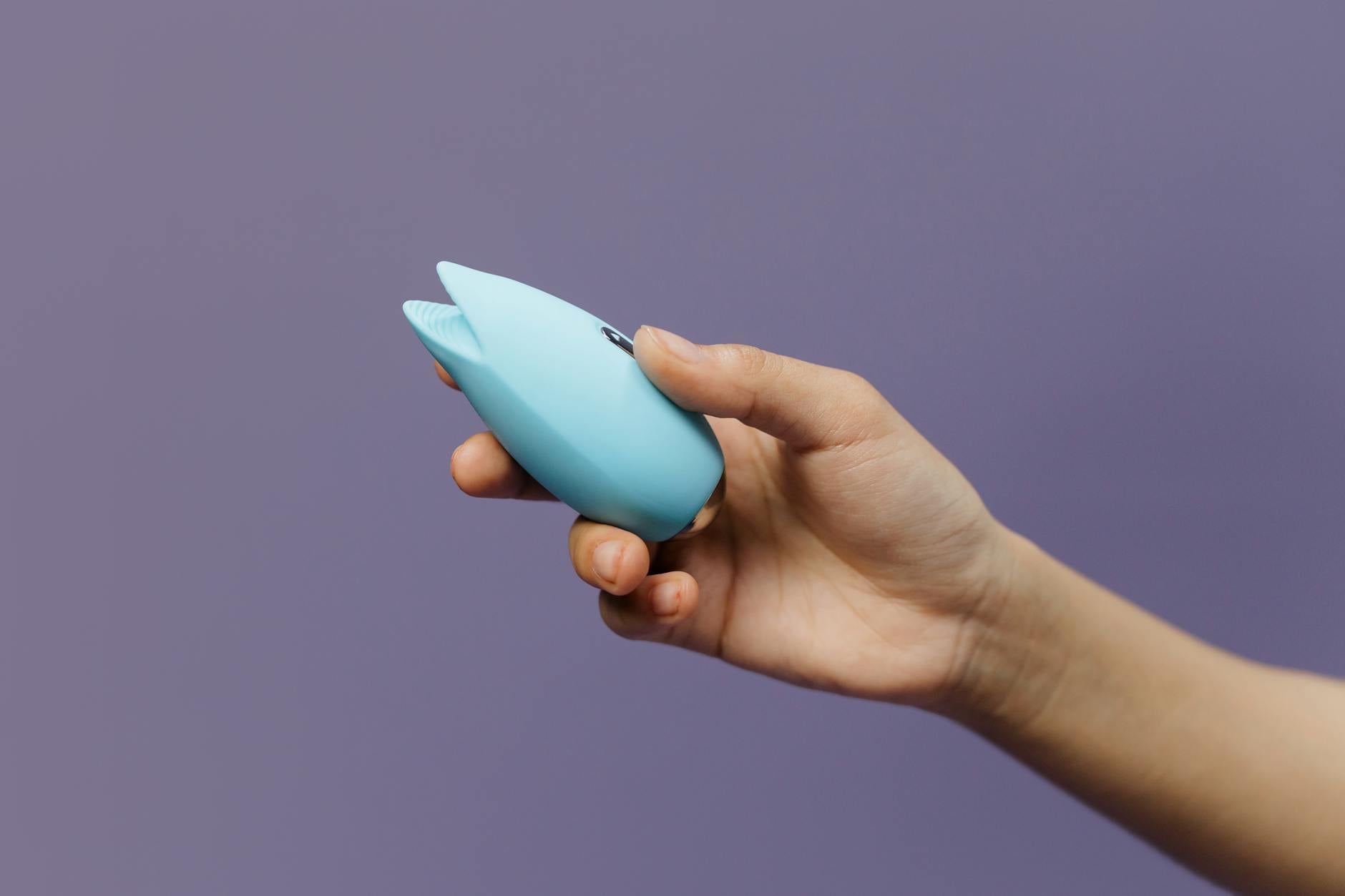
Photo by Olga Lioncat on Pexels
Tracking helps you predict your own pattern
Hormonal cycles vary wildly. Some people have predictable 28-day cycles. Others run 21 to 35 days. Some have irregular cycles or are on hormonal birth control that completely flattens the normal hormone curve. The only useful cycle is your actual cycle.
Spending two or three months tracking when you feel most responsive with your lemon vibrator, when you need more time to warm up, when higher settings feel better will teach you more than any general article ever could. Note when you use your vibrator, what settings felt good, how long it took to reach climax. After a few cycles, you'll see your own pattern emerge.
If you're on hormonal birth control (the pill, patch, ring, implant), your cycle is being suppressed or heavily modified. You probably won't see the same dramatic swings. That's the point of the medication. But some people still notice subtle shifts week to week based on the placebo week or how their individual body metabolizes the hormones.
When sensitivity changes warrant a doctor's visit
There's a difference between "I feel less responsive this week of my cycle" and "I feel numb all the time, regardless of cycle phase." If your sensation has genuinely decreased overall, not just fluctuated cyclically, talk to a gynecologist. This can signal issues like hormonal imbalances, medication side effects, or pelvic floor dysfunction.
Likewise, if one specific phase of your cycle is painfully hypersensitive (where even gentle touch from your lemon clitoral vibrator feels aggressive), that's worth mentioning to your doctor. This can sometimes indicate hormonal sensitivity or nerve issues worth exploring.
The bigger picture
Your body isn't betraying you when sensation shifts across your cycle. It's doing exactly what it's supposed to do. Hormones are supposed to fluctuate. Sensitivity is supposed to shift. Desire is supposed to have a rhythm.
When you stop fighting those natural cycles and instead adapt your approach, you often find that pleasure becomes more available, not less. A lemon vibrator, lem vibrator, or any clitoral toy becomes more effective because you're using it in alignment with your body's actual state, not against it.
Common questions about hormones and vibrator sensation
Why does my clitoral vibrator feel numb right before my period?
Your body is preparing for menstruation by reducing blood flow to the reproductive system. Progesterone is also at its peak, which increases baseline anxiety and can make focus harder. The combination dampens sensation. This usually rebounds within a few days of your cycle restarting. Using lube and extending warm-up time helps.
Can I use my lemon vibrator during my period?
Yes. Bleeding doesn't make the vibrator unsafe. Some people find that orgasms during their period feel more intense because uterine contractions are already happening. Others find that cramping makes them less interested. Your body, your call. If you do use it, make sure the toy is clean, and be aware that you might bleed on it (it washes off easily).
Does hormonal birth control change how vibrators feel?
Yes. The pill, patch, and ring suppress hormonal fluctuations, which smooths out the dramatic swings in sensitivity you'd experience with a natural cycle. Some people on hormonal birth control notice they feel consistently moderately responsive. Others notice they have less desire overall (a known side effect of certain formulations). If sensation or desire has shifted since starting birth control, talk to your prescriber about whether a different formulation might work better.
Why do I get more pleasure from my vibrator mid-cycle?
That's ovulation week. Testosterone spikes, estrogen is high, and the clitoral tissue is maximally engorged. Your neurology is literally configured for maximum sensation during this window. It's not psychological. It's biology.
Is it normal for orgasms to feel different throughout my cycle?
Completely normal. Orgasms during high-estrogen phases are often more intense and localized. During low-estrogen phases, they might feel more diffuse or take longer to build. Both are fine. Your nervous system is responding to hormonal conditions.
If I'm struggling with numbness, should I see a doctor?
If you're experiencing numbness that isn't tied to your cycle phase (it's constant), yes. Numbness all month long can signal medication side effects, hormonal imbalances, pelvic floor dysfunction, or nerve issues. That's worth getting evaluated.
What comes next
Start noticing your own pattern. Use your lemon vibrator across all phases of your cycle and pay attention to what changes. Adjust your settings, warm-up time, and lube use based on what you discover. After a few months, you'll have a map of your own body that's infinitely more useful than any article.
Your pleasure isn't broken when it fluctuates. It's working exactly as designed. That's actually the whole point.
If you want to explore more about using vibrators effectively with your body's natural cycles, reach out. I'm here to help you understand your own pleasure blueprint.